ERPs for Aerospace and Defense Manufacturing

The ERP Landscape For Advanced Manufacturing: What Space, Aerospace, Defense, And Nuclear Teams Actually Use
Between 55% and 75% of ERP implementations fail to meet their objectives, according to Gartner. In advanced manufacturing — aerospace, defense, nuclear, space, and robotics — the cost of picking the wrong system is measured in lost contracts, stalled production, and compliance violations. Not just lost budget.
This post maps the ERP landscape as it actually exists for advanced manufacturing teams. No analyst tiers. No vendor rankings. Just what teams use, where each system fits, and the procurement gap none of them close.
What Makes ERP Selection Different For Aerospace, Defense, And Nuclear
Most ERP buyer's guides assume you run a consumer goods company. Advanced manufacturing is a different world.
Compliance is non-negotiable. International Traffic in Arms Regulations (ITAR), AS9100, FAR/DFARS, SOC 2, FedRAMP, Nadcap — these dictate where your data lives, who can access it, and how every part is traced from raw material to final assembly. Miss one requirement and you lose the contract.
Bills of Materials (BOMs) are complex. Multi-level BOMs with hundreds of line items, engineering change orders (ECOs) mid-build, and long-lead components sourced from a small pool of qualified suppliers. Your ERP needs to handle this without drowning engineering in manual data entry.
Traceability is the baseline. Every part, every lot, every supplier deviation needs a paper trail. Auditors from prime contractors and government agencies will pull that thread. If your system cannot produce it in minutes, you have a problem.
Data residency matters. ITAR-controlled data cannot sit on servers outside the United States. FedRAMP and SOC 2 add further constraints. Not every ERP vendor meets these requirements out of the box.
The key question: does the ERP support these requirements natively, or will your team spend 12 to 18 months customizing it to get there?
The ERPs Advanced Manufacturers Actually Use
The market breaks into four categories based on fit — not prestige.
Full-Suite Enterprise ERPs
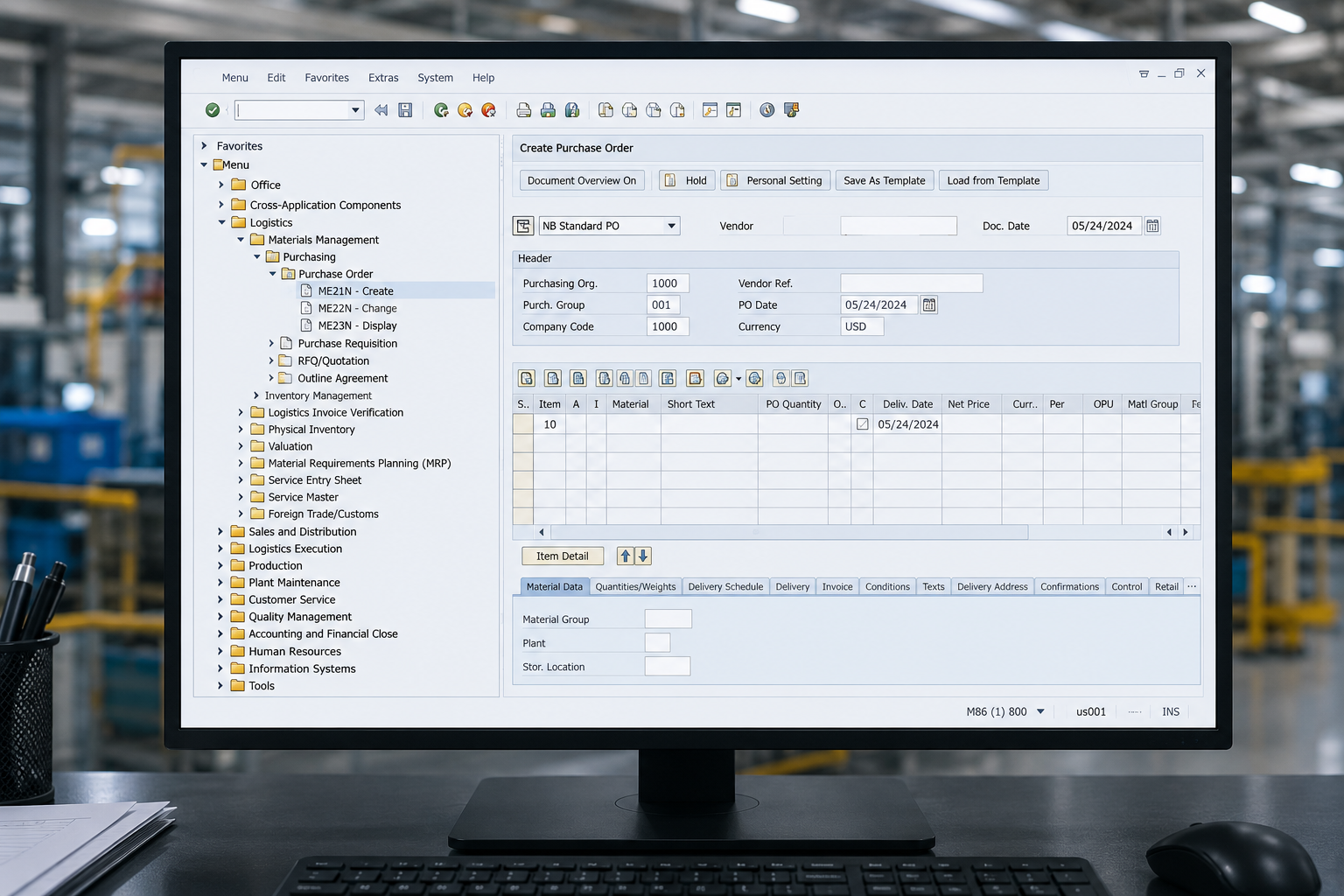
SAP S/4HANA and Oracle Fusion/EBS serve defense primes and multi-national manufacturers. These systems handle massive scale, multi-entity consolidation, and deep configuration.
They are also expensive. Implementations routinely run 18 to 36 months for aerospace and defense (A&D). Total cost of ownership (TCO) is high. Customization is heavy. You will need a dedicated internal team or a systems integrator — often both. For mid-size manufacturers, the risk of a stalled or failed implementation is real.
Compliance-Deep ERPs
IFS Cloud, Infor CloudSuite LN/SyteLine, and Epicor Kinetic are purpose-built for aerospace and defense manufacturing. These are the workhorses for more mature upper mid-market manufacturers with sophisticated demand planning and Material Requirements Planning (MRP) needs.
Implementation timelines are shorter than full-suite enterprise ERPs — typically 6 to 12 months. These systems understand A&D workflows natively: project-based manufacturing, progress billing, government contract accounting, and lot/serial traceability. They are the natural step up when a growing manufacturer outgrows a finance-first ERP and needs real MRP depth.
Finance-First ERPs
NetSuite, Microsoft Dynamics 365, and Acumatica are the preferred path for modern hardware companies doing discrete manufacturing. In this world, demand planning is less critical. Accounting and finance are priority number one.
NetSuite is by far the most popular choice. Finance and Accounting teams tend to love it — strong general ledger, revenue recognition, and reporting. But other functions find the workflow experience wanting. Procurement, engineering, and operations teams often work around NetSuite rather than through it.
These systems work best when paired with specialized tools for the workflows they do not cover well: supplier management, quality tracking, and shop floor execution.
MES Platforms
First Resonance ION, Manufacturo, and Boltline are not ERPs. They are Manufacturing Execution Systems (MES). Many hardware companies use an MES as their hub system early on because the immediate priority is building and shipping hardware — fast.
These platforms handle work orders, build tracking, and shop floor execution. As the company matures and accounting and compliance requirements grow, teams typically pair their MES with a finance-first ERP (usually NetSuite) to cover the financial side.
How The Four Categories Compare
Reputation Vs. Reality: What Analysts Miss About ERP Fit
Analyst rankings — Gartner Magic Quadrant, Forrester Wave — reward breadth of functionality and global scale. That makes SAP and Oracle perennial leaders. But breadth is not the same as fit.
SAP and Oracle are powerful. They are also risky bets for mid-size advanced manufacturers. The implementation complexity, the consultant costs, and the organizational change management required can overwhelm a 200-person company.
IFS, Infor, and Epicor do not always land at the top of analyst reports. But they are the systems that mature A&D manufacturers with real MRP and compliance needs actually run on every day. They understand the domain.
NetSuite is the default for modern hardware companies building physical products. Finance loves it. Everyone else builds workarounds. That is not a knock — it is the reality of choosing a finance-first system for a manufacturing operation.
MES platforms are not a substitute for an ERP. But they are the right starting point for teams that need to ship hardware before they need a general ledger. The mistake is thinking you have to choose one or the other upfront. Many successful teams start with MES, add NetSuite for finance, and grow from there.
Where Every ERP Falls Short: Supplier Collaboration
Here is the gap none of these systems close.
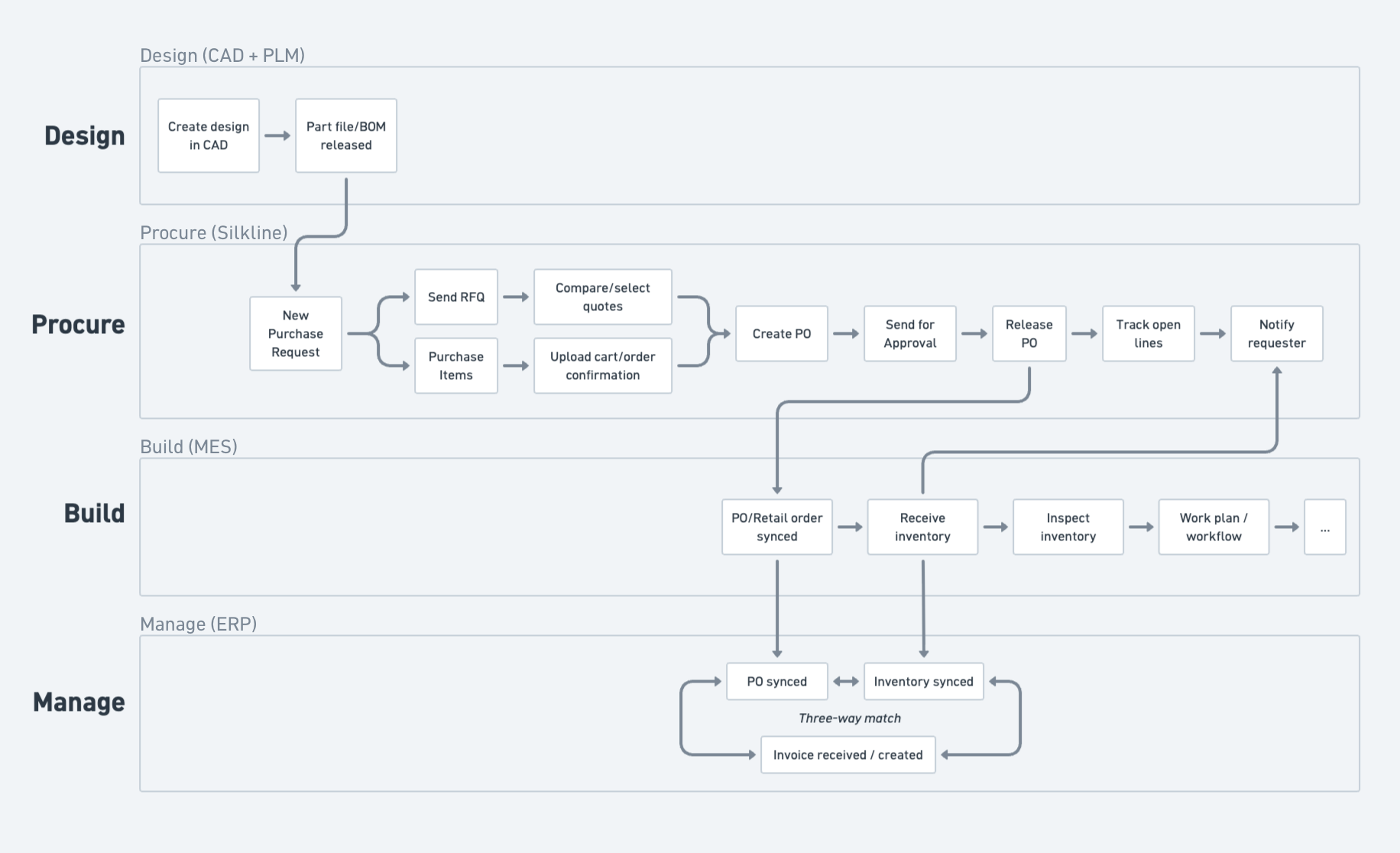
ERPs are systems of record. They track what happened — the Purchase Order (PO), the receipt, the invoice. They do not orchestrate what needs to happen next.
They do not chase the supplier for a PO acknowledgment. They do not flag that a critical long-lead item is three weeks late before it becomes a line-down event. They do not extract data from the PDF quote your supplier emailed and match it to the Request for Quote (RFQ).
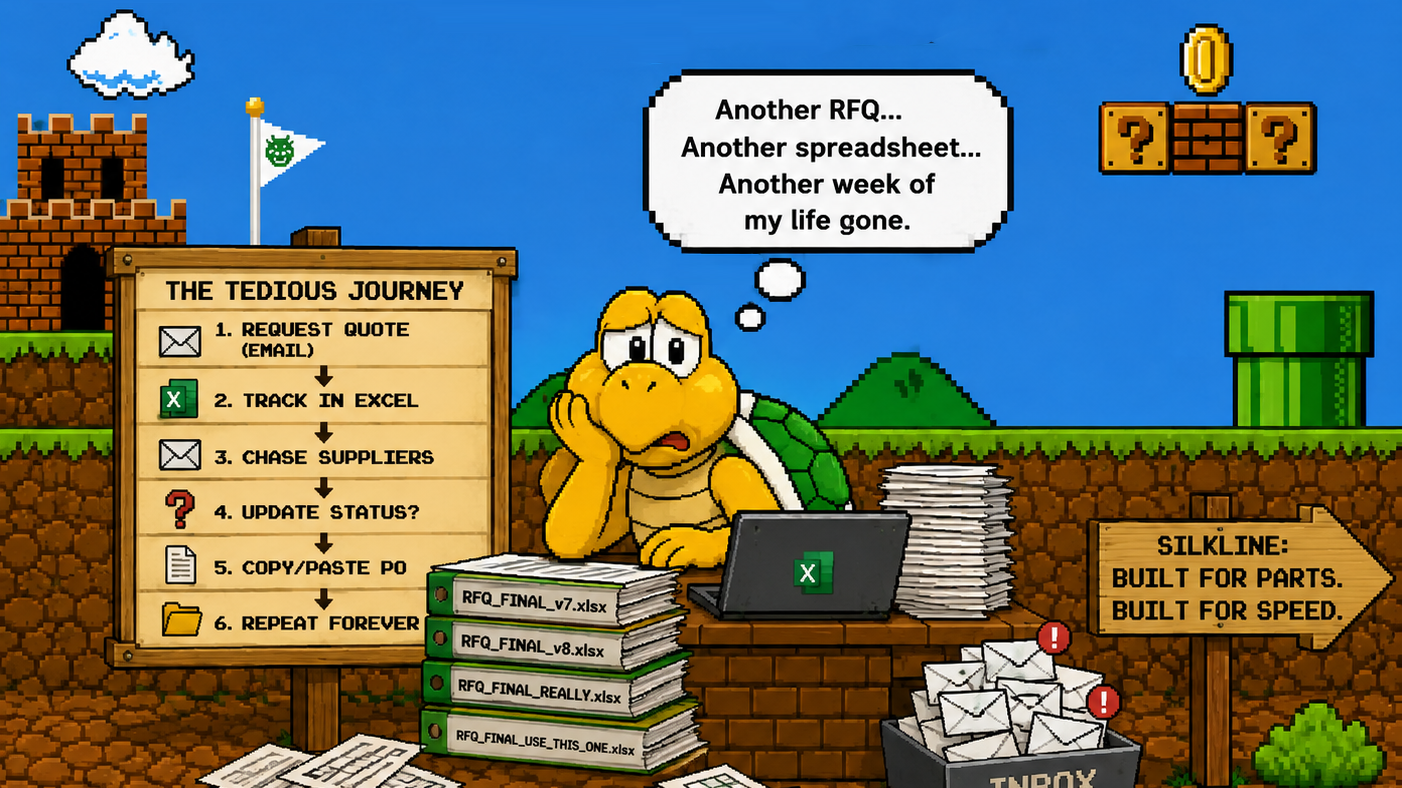
The procurement lifecycle — from engineering request to RFQ to PO acknowledgment to delivery and Certificate of Conformance (CoC) collection — lives in email, spreadsheets, and the heads of your buyers. Your ERP does not touch it. Teams typically spend 30 to 45 minutes per PO on manual follow-ups: checking inboxes, updating trackers, asking suppliers "where's my stuff?"
The fix is not replacing your ERP. It is adding an orchestration layer on top.
Silkline is one example of this approach. It overlays NetSuite, Infor LN/SyteLine, Oracle EBS, First Resonance ION, and Manufacturo. It automates supplier follow-ups via email — no portal, no supplier login. Teams using this kind of orchestration layer typically see RFQ cycle times drop from days to hours and a 40% to 60% reduction in manual follow-up touches per order within the first 30 days. The ERP stays. The chaos around it shrinks.
Your ERP Evaluation Checklist For Advanced Manufacturing
Run through these before your next vendor demo.
- Map your compliance requirements first. List every regulation, certification, and data residency requirement your contracts demand (ITAR, AS9100, FAR/DFARS, SOC 2, Nadcap). Ask each vendor: is this native, configurable, or custom?
- Audit your BOM complexity. If you have multi-level BOMs with frequent ECOs, you need a system that handles engineering changes without manual re-entry. Run a test with your actual data — not the vendor's demo data.
- Assess your MRP maturity. If you have mature demand planning and scheduling needs, a compliance-deep ERP (IFS, Infor, Epicor) is likely the right fit. If your priority is getting finance and accounting right for discrete manufacturing, a finance-first ERP will get you there faster.
- Ask about supplier collaboration — then watch what happens. Most ERP vendors will mention a supplier portal. Ask how many of their customers' suppliers actually use it. The answer is usually telling.
- Plan for the procurement gap. Budget for a dedicated orchestration layer alongside your ERP. Your buyers are spending 30% to 50% of their time on follow-ups and status chasing that the ERP will not automate.
- Time-box your implementation. If the vendor cannot commit to a go-live timeline with clear milestones, that is a signal. The 18-month implementation that becomes 30 months is not an edge case — it is the norm for complex ERP projects.
Pick The System That Fits. Fill The Gaps It Leaves.
No ERP covers every workflow in advanced manufacturing. The teams that move fastest pick a system that matches their current maturity, pair it with specialized tools for the gaps, and build from there.
If you are evaluating your ERP stack and want to see how an orchestration layer handles the procurement workflows your ERP does not — Get a demo.
About Silkline
Silkline is the supply chain orchestration platform that advanced manufacturing companies use to collaborate with suppliers; track requests, RFQs, quotes, and orders; and monitor team and vendor performance. Our technology sets the standard for how OEMs engage their supply base and is the connective layer for hard tech supply chains. Hundreds of advanced manufacturers use Silkline to operate more efficiently and speed up time to revenue. The company is headquartered in Chicago, IL. For additional information, visit https://www.silkline.ai.
© 2026 Silkline, Inc. All rights reserved. Silkline and the Silkline logo are trademarks of Silkline, Inc. All other brand and product names are trademarks or registered trademarks of their respective holders.